Osteoporosis in PCMC: Why Bone Density is the Hidden Foundation of Your Joint Health
By Dr. Vishal Patil
Best Orthopedic Surgeon in Aundh & Pune
Imagine building a high-tech, multi-crore skyscraper on a foundation of shifting sand.
No matter how advanced the glass, the steel, or the architecture, the building is only as stable as the ground beneath it. In the world of orthopedics, your bones are that foundation, and your joints are the architecture.
Meet Mrs. Shinde, a 65-year-old resident of Pimpri. She was active, loved her evening walks at the local park, and had recently started considering a knee procedure to deal with chronic aches. One morning, a minor slip on a wet kitchen floor changed everything. It wasn’t a high-impact fall, yet it resulted in a shattered hip. Why? Because while Mrs. Shinde was focused on her “joint pain,” a silent thief called Osteoporosis had been hollowed out her bones for over a decade.
In the industrial and residential hubs of PCMC and Aundh, we are seeing a “silent epidemic.” Osteoporosis is often overlooked until it’s too late, but it is the hidden foundation that determines the success of every joint treatment, from physical therapy to robotic surgery.
What is Osteoporosis? The “Silent” Architecture of Bone
Osteoporosis is a metabolic bone disease characterized by low bone mass and the micro-architectural deterioration of bone tissue. Essentially, your bones become porous, brittle, and highly susceptible to Fractures / Trauma / Accident.
Under a microscope, healthy bone looks like a honeycomb. In an osteoporotic bone, the “holes” in the honeycomb are much larger, meaning the internal support structure is failing.
Because this process is painless, many people in Pune don’t realize they have it until they suffer a fragility fracture—a break that occurs from a fall at standing height or less.
The BMD Test: Your Diagnostic “X-Ray” Into the Future
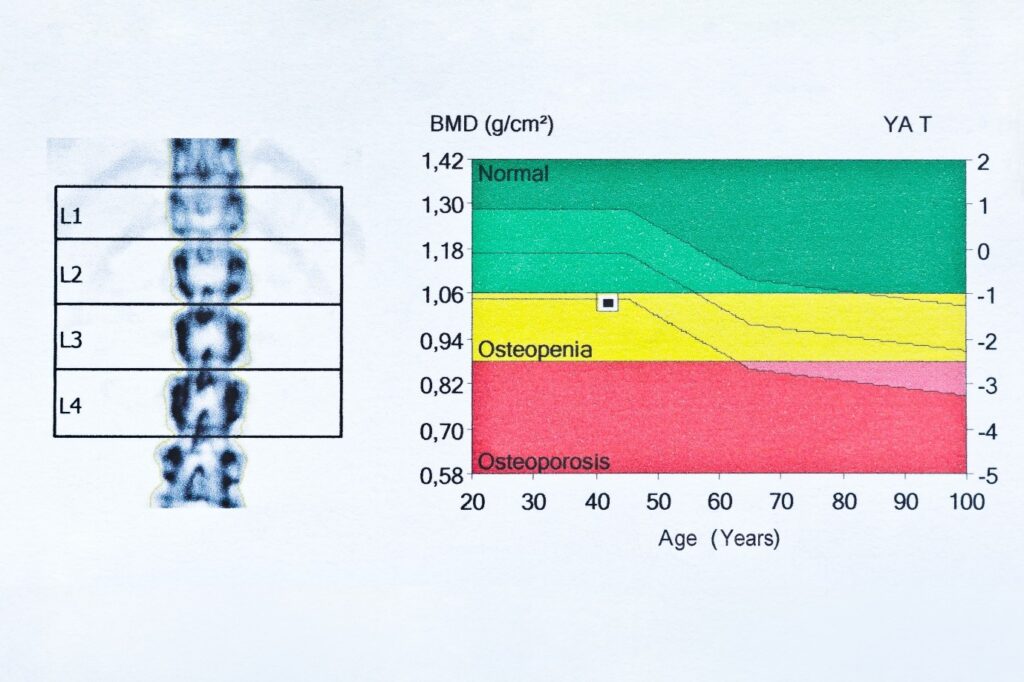
How do we catch this thief before it steals your mobility? The gold standard is the Bone Mineral Density (BMD) test, typically performed via a DEXA scan. As highlighted by diagnostic experts like those at Dhanashree Hospital, a BMD test measures the amount of calcium and other bone minerals in a specific segment of bone, usually the hip and spine.
A BMD test provides a “T-score”:
-1.0 or higher: Normal bone density.
-1.0 to -2.5: Low bone mass (Osteopenia).
-2.5 or lower: Osteoporosis.
For post-menopausal women and men over 65 in the PCMC belt, this test is as essential as a blood pressure check. It tells us if your “foundation” is strong enough to support your lifestyle.
Why Bone Density Matters for Joint Replacement
As a Best Joint Replacement Surgeon in Pune, I often have to explain to patients that a successful surgery is a partnership between the surgeon’s skill, the technology, and the patient’s bone quality.
The Success of Robotic Surgery
We use Robotic Knee Replacement Surgery to achieve sub-millimeter precision. However, the robotic system places an implant onto your natural bone. If that bone is soft due to osteoporosis, the implant may not seat correctly or could shift over time. Ensuring high bone density before surgery significantly improves the “natural feel” and longevity of the joint.
Minimally Invasive Procedures
In Minimally Invasive Subvastus Knee Replacement Surgery, we protect the muscles and soft tissues. But the bone must be strong enough to withstand the immediate weight-bearing we encourage after the operation. Strong bones allow for the “Walking by Sundown” recovery we strive for.
Avoiding the “Revision” Trap
When bone quality is poor, the risk of the implant loosening increases. This leads to the need for a Revision Knee Replacement or a Revision Hip Replacement. Revisions are more complex and require even more bone support. By managing osteoporosis early, we aim to make your primary Hip Replacement or knee replacement a “once-in-a-lifetime” event.
The Domino Effect: Beyond the Knee and Hip
Osteoporosis doesn’t just affect the joints we usually think of. It impacts the entire Ortho system.
Shoulder Health: Weak bones can complicate a Shoulder Arthroscopy used to fix a Ratator cuff tear. If the bone at the attachment site is too soft, the repair is less stable, potentially leading to a Recurrant shoulder dislocation.
Avascular Necrosis (AVN): For patients dealing with Avascular Necrosis (AVN), where bone tissue dies due to lack of blood supply, underlying osteoporosis can accelerate the collapse of the joint, making a Total Hip Replacement Surgery necessary much sooner.
Shutterstock
The Roadmap to Stronger Bones: Prevention and Management
If your BMD test shows low density, it is not a “life sentence.” Bone is living tissue that can be strengthened.
Nutrition: Ensure adequate intake of Calcium and Vitamin D. In the urban environment of Pune, Vitamin D deficiency is surprisingly common due to indoor lifestyles.
Weight-Bearing Exercise: Activities like walking or light resistance training signal your bones to grow denser. Our General Physical Therapy team can design a safe “Bone-Building” routine for you.
Medical Management: For those with confirmed osteoporosis, medications (like bisphosphonates) can help slow bone loss and even increase density over time.
Post-Fracture Care: If you’ve already suffered a break, Post-Op Physical Therapy is vital to regain mobility while protecting the fragile bone as it heals.
Conclusion: Don’t Wait for the Break
Osteoporosis is a “silent” disease, but it doesn’t have to be a “secret” one. By understanding your bone density today, you are protecting your ability to walk, trek, and play tomorrow.
Whether you are considering a Total Hip Replacement Surgery or simply want to ensure you can stay active in your 70s, the foundation starts with your bone density.
Consult Dr. Vishal Patil Today
Expert in Robotic Joint Replacement & Bone Health
📍 Address: DR PATIL’s Shree Orthopedic and Womencare Clinic, Shop No 205, Second Floor, Gaikwad Villa, Seasons Rd, Aundh, Pune 411067.
(Opposite Punjab National Bank, Sahil Park, Sanewadi)
📞 Phone: +91 94054 31728
🌐 Website: drvishalpatil.in