Transitional Care vs. Home Physio: Why Patients in Rehab Centers Recover 37% Faster
By Dr. Vishal Patil
Best Orthopedic Surgeon in Aundh & Pune
The surgery was a masterpiece of robotic precision. The incisions were minimal, the alignment was perfect, and the new joint was rock-solid. But as the patient was wheeled out of the hospital, a new, invisible clock started ticking.
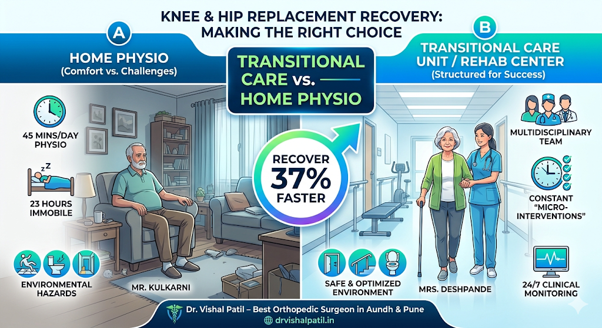
Meet Mr. Kulkarni, a 68-year-old retired engineer from Aundh. After his successful Robotic Knee Replacement Surgery, he had two choices. Option A: Go straight home and have a physiotherapist visit him for 45 minutes a day. Option B: Spend two weeks in a dedicated Transitional Care Unit (TCU)—a specialized rehab center designed to bridge the gap between hospital and home.
Mr. Kulkarni chose Option A. He figured he would be more comfortable in his own bed. However, three weeks later, he was struggling. His home had narrow corridors, his bed was too low, and he spent 23 hours a day essentially immobile, waiting for his daily physio session.
Contrast this with Mrs. Deshpande, who underwent the same procedure but opted for Transitional Care. By the time she returned to her home in Pune, she wasn’t just “healing”; she was thriving.
According to a landmark study highlighted by Semantic Scholar, patients in structured transitional care environments recover functional mobility up to 37% faster than those relying solely on home-based therapy. This isn’t just about comfort; it’s about the science of the “Golden Window” of recovery.
What is Transitional Care? (And Why 37%?)
Transitional care is a multidisciplinary approach to recovery that takes place in a controlled, clinical environment. Unlike home-based care, where therapy is a “guest” in your daily life, in a rehab center, recovery is the daily life.
The 37% faster recovery rate isn’t magic—it’s the result of three specific factors that home environments simply cannot replicate:
The Power of “Micro-Interventions”
At home, you might do your exercises once or twice a day when the therapist arrives. In a transitional center, you are under the constant guidance of a Post-Op Physical Therapy team. They don’t just see you for an hour; they correct your posture as you walk to the dining hall, adjust your chair height, and encourage “micro-movements” every hour. This consistency prevents the joint from stiffening—a common issue after a Revision Knee Replacement.
Environmental Optimization
Most Pune apartments are not built for post-surgical recovery. Slippery tiles, high door sills, and low toilets are hidden hazards that cause “guarding”—a psychological state where the patient moves tentatively out of fear of falling. This fear slows down healing. In a rehab center, every inch of the environment is designed to promote confidence and safety, which is especially vital after a Total Hip Replacement Surgery.
24/7 Clinical Monitoring
Recovery isn’t always linear. Sometimes there is swelling; sometimes there is a localized fever. In a transitional care facility, nursing staff can spot these signs immediately. This reduces the risk of readmission, which is a major factor for complex cases involving Avascular Necrosis (AVN) or Revision Hip Replacement.
The Domino Effect: Why Your First Two Weeks Determine Your Next Ten Years
As the Best Joint Replacement Surgeon in Pune, I often tell my patients that my job in the operating room is only 50% of the success story. The other 50% is decided in the first 14 to 21 days post-surgery.
If you fail to achieve a specific range of motion in those first two weeks, scar tissue (fibrosis) can set in. Once that tissue hardens, it is incredibly difficult to “undo” the stiffness. Whether you’ve had a Minimally Invasive Subvastus Knee Replacement Surgery or a Hip Replacement, the “37% advantage” of transitional care ensures you hit your mobility milestones before scar tissue has a chance to form.
Protecting the Upper Body
The need for structured rehab isn’t limited to the lower body. Patients recovering from Shoulder Arthroscopy due to a Ratator cuff tear or a Recurrant shoulder dislocation often struggle with “frozen shoulder” if their home exercises aren’t performed with the correct intensity. Transitional care provides the professional oversight to ensure every stretch is productive but safe.
Home Physio: When Does It Make Sense?
Is Home Physio “bad”? Absolutely not. In fact, General Physical Therapy at home is an excellent option for:
Maintenance Phase: After the initial high-intensity rehab is complete.
Minor Injuries: Recovering from minor Fractures / Trauma / Accident where 24/7 monitoring isn’t required.
High-Functioning Patients: Younger, active adults who have an “ergonomically optimized” home and a dedicated caregiver.
However, for a major Ortho procedure, the “Transitional” model is the gold standard for a reason. It removes the variables of daily life and replaces them with a single-minded focus on your mobility.
The Reality of Rehab in Pune
In the bustling areas of Aundh and PCMC, we are seeing a shift. More families are realizing that they aren’t “abandoning” their elders by placing them in transitional care—they are giving them a specialized medical advantage.
The goal of every surgery I perform—whether it’s a primary joint replacement or a complex Revision Knee Replacement—is to ensure the patient never feels like a “patient” again. Transitional care is the fastest bridge to that reality.
Conclusion: Don’t Leave Your Recovery to Chance
You’ve invested time, emotion, and resources into your surgery. Don’t let the “last mile” of your journey be the weakest link. By choosing a structured transitional environment, you aren’t just recovering; you are ensuring that your new joint serves you for the next 20 years.
If you are planning a surgery or are currently in the “pre-hab” phase, let’s discuss which recovery path is right for your specific needs.
Consult Dr. Vishal Patil Today
Expert in Robotic Surgery & Advanced Orthopedic Rehab
📍 Address: DR PATIL’s Shree Orthopedic ah, Pune 411067.
(Opposite Punjab National Bank, Sahil Park, Sand Womencare Clinic, Shop No 205, Second Floor, Gaikwad Villa, Seasons Rd, Aundnewadi)
📞 Phone: +91 94054 31728
🌐 Website: drvishalpatil.in