The “Dry Bathroom” Switch: Modifying Your Pune Home for a Safe Post-Surgery Recovery
By Dr. Vishal Patil Best Orthopedic Surgeon in Aundh & Pune
The surgery was a flawless success. The robotic precision was sub-millimeter, the implant was perfectly seated, and the patient was discharged with a smile. But forty-eight hours later, the phone in my Aundh clinic rang with the news every surgeon dreads: a slip in the bathroom.
Meet Mr. Deshpande, a 68-year-old retired officer from Baner. He had just undergone a life-changing Total Hip Replacement Surgery. He was recovering beautifully until he entered his traditional Pune bathroom. The floor was slightly damp from the morning humidity, the tiles were the standard “builder-grade” slippery variety, and the toilet seat was too low for his new hip’s range of motion. One small slip led to a major scare.
Fortunately, Mr. Deshpande did not dislocate his new joint, but his story is a vital lesson for every patient in Pune. We spend months preparing for the surgery, but we often forget that the most dangerous place in the world for a recovering patient is their own bathroom.
At Dr. Vishal Patil’s Shree Orthopedic and Womencare Clinic, we believe that “Walking by Sundown” shouldn’t just happen in the hospital; it must continue safely at home. Here is your survival guide to the “Dry Bathroom” switch.
Why the Bathroom is a Post-Op “Danger Zone”
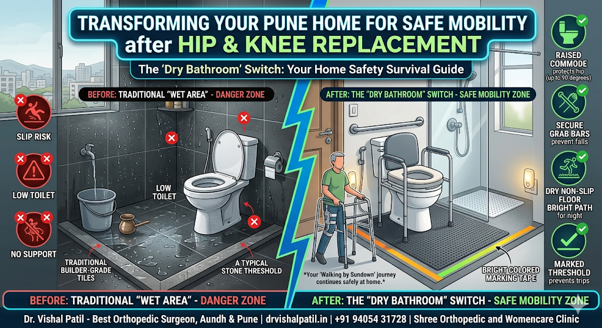
In a typical Pune apartment, bathrooms are designed as “wet areas.” The floor is often sloped for drainage, and water from a bucket bath frequently splashes across the entire surface. For a patient recovering from a Fractures / Trauma / Accident or a joint replacement, this environment is a recipe for disaster.
Post-surgery, your proprioception (the brain’s ability to sense where your limb is) is temporarily altered. Your muscles are in the early stages of Post-Op Physical Therapy, and your balance isn’t yet 100%. A single wet tile can undo the work of the best Ortho surgeon in minutes.
Step 1: The Commode Chair Revolution
The standard height of many Indian toilets (and even some Western ones) is too low. After a Hip Replacement, bending your hip beyond 90 degrees can be dangerous in the early weeks.
This is where the “Dry Bathroom” switch begins. Utilizing a high-quality commode chair is a non-negotiable for the first 6 to 12 weeks. These chairs:
Reduce the “Sit-to-Stand” Strain: Higher seating protects your new joint from excessive stress.
Provide Side Support: Built-in armrests give you something stable to hold onto, which is crucial if you are also managing a Ratator cuff tear or recovering from Shoulder Arthroscopy.
Allow for “Dry” Usage: You can place the commode chair in a dry part of the bathroom or even in the bedroom at night to avoid walking on wet floors in the dark.
Step 2: Eliminating the “Slippery Slope”
If you cannot remodel your bathroom into a modern “walk-in” shower before surgery, you must focus on friction.
Non-Slip Mats: Invest in high-suction, anti-fungal rubber mats. Place them inside the shower area and, more importantly, right outside the door.
Grab Bars: Do not rely on towel racks or plastic soap holders for balance. Install industrial-grade grab bars near the toilet and in the shower. These bars are the anchor for your safety, especially for those who have undergone Robotic Knee Replacement Surgery and need steady support while bending.
Step 3: Lighting and Thresholds
Many falls happen at night. Ensure your bathroom path is lit with motion-sensor nightlights. Furthermore, many Pune flats have a 1-inch “stone threshold” at the bathroom door to keep water inside. For a patient using a walker after a Minimally Invasive Subvastus Knee Replacement Surgery, this small bump is a major trip hazard. Use a small rubber ramp or brightly colored tape to mark the threshold.
The Domino Effect: Why Home Safety Prevents Revision Surgery
As a Best Joint Replacement Surgeon in Pune, my primary goal is to ensure you never need a Revision Knee Replacement or a Revision Hip Replacement.
Implant technology has reached a point where joints can last 20-30 years. However, a major fall in the first 90 days can cause a periprosthetic fracture or loosen the implant from the bone. If you have been treated for Avascular Necrosis (AVN), your bone density might already be a concern, making home modifications even more critical.
Synergy: Safety + Therapy
Modifying your home works hand-in-hand with your General Physical Therapy. While the therapist works on your “internal” stability, the “Dry Bathroom” provides “external” stability.
For patients who have suffered a Recurrant shoulder dislocation, having a modified bathroom means they don’t have to use their injured arm to push off low surfaces, protecting the surgical repair while the tissue heals.
Your Home Modification Checklist:
[ ] Commode Chair: Height-adjustable with armrests.
[ ] Grab Bars: Securely bolted into the wall (not suction-cup).
[ ] Lighting: Nightlights from bed to bathroom.
[ ] Floor: Remove all loose rugs; replace with non-slip backing.
[ ] Accessibility: Move frequently used toiletries to waist height to avoid reaching or bending.
Conclusion: Don’t Leave Your Recovery to Chance
You’ve invested time, emotion, and finances into your surgery. The “Dry Bathroom” switch is a small but powerful investment in your future. By modifying your Pune home, you aren’t just preventing a fall; you are ensuring that your recovery is as precise and successful as the surgery itself.
If you are planning an upcoming procedure, let’s discuss your home environment during your next consultation at our Aundh clinic. We want to ensure that every step you take—at the hospital and at home—is a step toward total mobility.
Consult Dr. Vishal Patil Today
Expert in Robotic Surgery & Advanced Orthopedic Care
📍 Address: DR PATIL’s Shree Orthopedic and Womencare Clinic, Shop No 205, Second Floor, Gaikwad Villa, Seasons Rd, Aundh, Pune 411067.
(Opposite Punjab National Bank, Sahil Park, Sanewadi)
📞 Phone: +91 94054 31728
🌐 Website: drvishalpatil.in