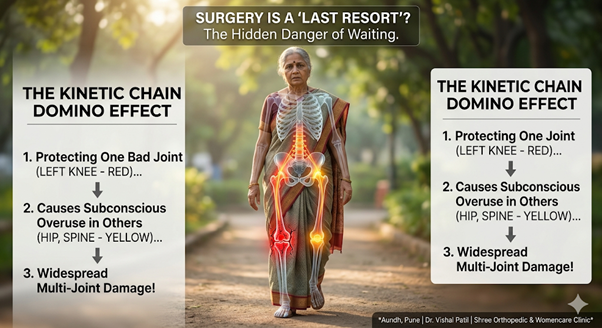
Surgery is a Last Resort: Why Delaying Treatment is Actually Damaging Your Healthy Joints
By Dr. Vishal PatilBest Joint Replacement Surgeon in Pune
I’ll just wait until I can’t walk anymore.
It is a phrase I hear almost every day at my clinic in Aundh. Patients like Mrs. Kulkarni, a 62-year-old retired teacher, often come to me after five years of “managing” a bad left knee with pain balms and prayers. She prided herself on her “pain tolerance,” viewing surgery as a failure or a “last resort.”
But when I examined her, the tragedy wasn’t just her worn-out left knee. It was her right hip and her lower spine. Because she had spent half a decade limping to protect one joint, she had unintentionally destroyed two others.
The “Surgery as a Last Resort” mindset is perhaps the most dangerous myth in modern Ortho. According to clinical research, including insights from the National Center for Biotechnology Information (NCBI), delaying necessary intervention doesn’t just prolong your pain—it causes a “domino effect” that damages your healthy joints.
The Domino Effect: The Kinetic Chain Problem
Your body is not a collection of isolated parts; it is a kinetic chain. When one link (like your knee) fails, the rest of the chain has to compensate.
When you have a “bad” knee, you subconsciously shift your weight to the other side. This creates an unnatural load on your “good” knee and hip. Over time, this leads to overuse injuries in joints that were perfectly healthy. We often see patients who delay a Hip Replacement for so long that by the time they arrive for surgery, they also need Minimally Invasive Subvastus Knee Replacement Surgery on the opposite side.
[Multimedia Suggestion: An infographic showing the ‘Kinetic Chain’—visualizing how a limp in the knee travels up to the hip and spine.]
The Muscle Atrophy Trap
One of the most significant dangers of “waiting it out” is muscle wasting. To protect a painful joint, you stop moving. When you stop moving, the muscles surrounding the joint—your “natural shock absorbers”—begin to shrink.
By the time a patient finally agrees to a Total Hip Replacement Surgery after years of inactivity, their muscles are so weak that the recovery process becomes twice as long. Surgery is much more successful when performed while the surrounding muscles are still strong enough to support the new implant.
The Bone-on-Bone Reality
Delaying treatment for conditions like Avascular Necrosis (AVN) or advanced osteoarthritis often leads to significant bone loss. When you wait until the “last resort,” the surgery becomes more complex.
Instead of a standard procedure, you might eventually require a Revision Knee Replacement or a Revision Hip Replacement much sooner because the initial foundation (your bone) was so degraded.
Why Modern Technology Changes the “Wait” Game
Twenty years ago, waiting made sense because implants didn’t last as long and recovery was brutal. Today, that logic is outdated.
Robotic Precision
With Robotic Knee Replacement Surgery, we now achieve sub-millimeter accuracy. This precision means less bone is removed, the fit is more “natural,” and the joint lasts significantly longer.
Minimally Invasive Techniques
We no longer have to “cut through” everything to fix the problem. For instance, Shoulder Arthroscopy allows us to repair a Ratator cuff tear or fix a Recurrant shoulder dislocation through tiny incisions. This means less pain and a faster return to your life in Pune.
The Cost of Living in Pain
Beyond the physical damage to your joints, there is the “Life Cost.”
Social Isolation: You stop going for walks at Chittaranjan Vatika or visiting friends because “it’s too much walking.”
Secondary Health Issues: Inactivity leads to weight gain, which then puts even more pressure on your joints, creating a vicious cycle of decay.
Chronic Inflammation: Constant joint pain keeps your body in a state of high inflammation, which can impact your heart and overall energy levels.
Whether you are recovering from Fractures / Trauma / Accident or managing a chronic condition, the goal of modern medicine is to keep you moving, not to wait until you are immobilized.
Reclaiming Your Walk: The Recovery Roadmap
If you aren’t ready for surgery, that’s okay. But “not having surgery” should not mean “doing nothing.” We often start with:
General Physical Therapy: To strengthen the supporting muscles and improve flexibility.
Lifestyle Modifications: Using ergonomic survival guides to reduce daily strain.
Post-Op Physical Therapy: For those who choose surgery, this is the key to ensuring your new joint thrives for 20+ years.
[Multimedia Suggestion: A 30-second video of Dr. Vishal Patil explaining the ‘Window of Opportunity’ for joint surgery.]
Conclusion: Don’t Wait for the “Last Resort”
Surgery is not a sign of defeat; it is a tool for liberation. When you delay treatment, you aren’t just “saving” a joint; you are sacrificing your healthy ones and losing years of active life.
If you are experiencing persistent pain, “popping” noises, or an inability to walk your usual distance, come in for an evaluation. Let’s look at your Ortho health holistically. Whether it’s a simple course of therapy or a life-changing Robotic Knee Replacement Surgery, the best time to act is before the damage spreads.
Your body was built to move. Let’s keep it that way.
Contact Dr. Vishal Patil TodayBest Orthopedic Surgeon in Aundh & Pune
📍 Address: DR PATIL’s Shree Orthopedic and Womencare Clinic, Shop No 205, Second Floor, Gaikwad Villa, Seasons Rd, Aundh, Pune 411067.
(Opposite Punjab National Bank, Sahil Park, Sanewadi)
📞 Phone: +91 94054 31728
🌐 Website: drvishalpatil.in