Robotic Surgery for the Young: Why Active Adults Benefit Most from Precision Alignment
By Dr. Vishal Patil Best Joint Replacement Surgeon in Pune
Isn’t 42 too young for a knee replacement?
Aniket, a high-performing project lead at a Hinjewadi IT firm and an avid weekend trekker, sat in my Aundh clinic with a mixture of frustration and disbelief. For three years, a sports injury from his college days had evolved into a “bone-on-bone” reality. He was stuck in a vicious cycle: he couldn’t trek because of the pain, and the inactivity was making his joints stiffer.
Aniket’s concern is the primary hurdle for the “Younger-Active” demographic. For decades, the medical consensus was to “wait as long as possible” for joint surgery because manual implants had a limited lifespan. But for the modern active adult, waiting isn’t just about enduring pain—it’s about losing the best years of their physical life.
Today, the “wait and suffer” era is over. The advent of Robotic Knee Replacement Surgery has shifted the paradigm, making precision alignment the secret weapon for adults who refuse to slow down.
The Precision Gap: Why “Good Enough” No Longer Works
In traditional knee surgery, a surgeon uses manual guides and the naked eye to align the implant. While skilled surgeons achieve great results, the margin for error is measured in millimeters. For a 70-year-old with low physical demand, a 3mm deviation might never be noticed.
However, for someone like Aniket, who wants to climb Sinhagad Fort or return to the badminton court, that same 3mm deviation is a disaster. It leads to uneven wear, a “mechanical” feel, and premature implant failure.
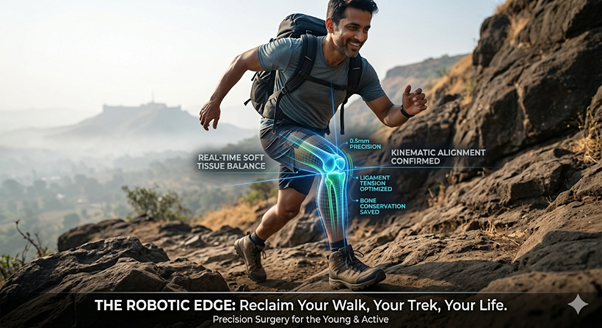
Research published by the National Center for Biotechnology Information (NCBI) highlights that robotic systems provide sub-millimeter accuracy and real-time “soft tissue balancing.” This means the robot doesn’t just look at the bone; it looks at how your ligaments tension throughout the entire range of motion.
Bone Preservation: Saving Your Natural Foundation
One of the greatest benefits of robotic precision for younger patients is bone conservation. Because the robotic arm uses a 3D virtual map of your unique anatomy, it only removes the precise amount of damaged bone required to fit the implant.
For an active adult, preserving as much natural bone as possible is critical. It leaves a stronger foundation for the joint and makes any potential Revision Knee Replacement much simpler thirty years down the line.
Kinematic Alignment: The “Natural Feel” Secret
The most common complaint after traditional surgery is that the knee feels “heavy” or “unnatural.” This is often because the implant is placed in a generic “mechanical” position.
Robotic systems allow for Kinematic Alignment, which mirrors the patient’s original, pre-disease joint line. For a young professional navigating the steep stairs of a Pune office or a trekker on uneven terrain, this “natural feel” is the difference between surviving the day and enjoying it. This is why many prefer Minimally Invasive Subvastus Knee Replacement Surgery, which avoids cutting the quadriceps muscle, further enhancing the natural recovery.
The Domino Effect: Protecting Your Other Joints
When a young adult “limps” through their 40s, they aren’t just saving a knee; they are destroying their other joints. A misaligned gait puts an unnatural load on the opposite knee, the lower spine, and the hips.
We often see patients who delayed knee treatment only to develop early-stage Avascular Necrosis (AVN) in the hip or require a Total Hip Replacement Surgery because their entire skeletal alignment was thrown off balance. By restoring precision in the knee early, you protect the rest of your “kinetic chain.”
Beyond the Knee: Precision for Every Active Joint
While robotic technology has revolutionized the knee, the philosophy of “Precision First” applies to all orthopedic care for active adults.
Shoulder Health: Active adults often face a Ratator cuff tear or a Recurrant shoulder dislocation. Utilizing Shoulder Arthroscopy ensures these issues are fixed via “keyhole” precision, allowing for a faster return to the gym.
Hip Stability: Whether it is a primary Hip Replacement or a complex Revision Hip Replacement, the goal is always to restore the patient to their pre-injury activity level.
The Recovery Roadmap: More Than Just Surgery
Surgery is the “reset button,” but recovery is where the victory is won. Active adults benefit from a structured Post-Op Physical Therapy program. Because robotic surgery involves less soft-tissue trauma, patients can often begin their exercises within hours of the procedure.
For those not yet requiring surgery, we focus on General Physical Therapy and Ortho diagnostics to manage pain and improve function. However, if you’ve suffered Fractures / Trauma / Accident, the speed of robotic-assisted intervention can be the deciding factor in whether you regain 100% of your former mobility.
Is it Time to Reclaim Your Active Life?
If you are a young or middle-aged adult in Pune, don’t let the fear of being “too young” keep you on the sidelines. Technology has caught up to your lifestyle.
The precision of robotic alignment means your new joint is built to withstand the rigors of an active life for 20 to 30 years. It’s time to stop managing your pain and start managing your return to the things you love.
Consult Dr. Vishal Patil Today
Best Orthopedic Surgeon & Robotic Specialist in Pune
📍 Address: DR PATIL’s Shree Orthopedic and Womencare Clinic, Shop No 205 second floor, Gaikwad Villa, Seasons Rd, opposite Punjab National Bank, Sahil Park, Sanewadi, Aundh, Pune, Maharashtra 411067.
📞 Book an Appointment: +91 94054 31728
🌐 Website: drvishalpatil.in