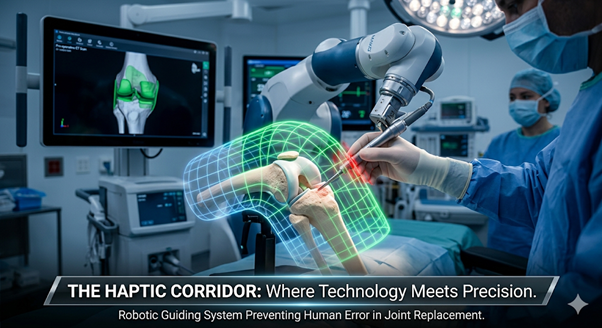
The Haptic Corridor: How Robots Prevent Human Error During Bone Preparation in Joint Replacement Surgery — The Moment That Changed Everything
Imagine a surgeon’s hand trembling by just 1 millimeter during your knee replacement. That 1 mm could mean the difference between walking pain-free for 20 years — or returning to the operating table within 5.
That single fact haunted joint replacement surgery for decades. Until the robot stepped in.
📖 A Story of Precision — Meet Meena Tai
Meena Tai, a 62-year-old homemaker from Aundh, Pune, had been living with debilitating knee pain for seven years. Three doctors had already told her she needed a Total Knee Replacement Surgery. She was terrified — not of the surgery itself, but of the outcome. “What if the implant isn’t placed right? What if my knee still feels wrong?”
When she arrived at Dr. Patil’s Shree Orthopedic and Womencare Clinic in Aundh, Dr. Vishal Patil explained something that immediately calmed her fears:
“Meena ji, we now use a technology called the haptic corridor — a robotic guiding system that physically stops the surgeon from cutting even 0.5 mm beyond the plan. Your bone preparation will be as precise as a spacecraft trajectory.”
Two months after her Robotic Knee Replacement Surgery, Meena Tai climbed the stairs of her building for the first time in seven years.
🤖 So, What Is the “Haptic Corridor”?
The term “haptic corridor” refers to a pre-defined, 3D virtual boundary created inside the robotic system — derived from your CT scan — within which a surgeon must operate during bone preparation.
Here’s the revolutionary part: the robot physically resists the surgeon’s hand if they move even slightly outside this corridor.
Think of it as a GPS system that doesn’t just warn you — it physically prevents your car from leaving the lane.
In orthopedic surgery, this is achieved through a technology called haptic feedback, now integrated into advanced systems like the MAKO Robotic Arm (Stryker) and CORI System (Smith & Nephew) — both of which have been validated in peer-reviewed research published by the American College of Surgeons (2025) and PubMed-indexed journals.
🦴 Why Bone Preparation Is the Most Error-Prone Step in Joint Replacement
During a Total Knee Replacement Surgery or Total Hip Replacement Surgery, the surgeon must precisely remove specific layers of bone from the femur and tibia before placing the implant. This is called bone resection or bone preparation.
In conventional surgery, this is done using manual jigs, intramedullary rods, and the surgeon’s trained eye.
The problem? Studies show conventional jig-based surgeries carry bone resection errors of up to ±3–5 mm, which can:
- Cause implant misalignment
- Lead to early implant loosening
- Require painful Knee Revision Surgery
- Result in 10–20% patient dissatisfaction post-surgery
A landmark study published in the Journal of Orthopaedic Case Reports (2026) involving 55 patients confirmed that MAKO robotic systems achieved bone cut accuracy within 1 mm in 95% of cases — a standard no manual technique can consistently match.
⚙️ How the Haptic Corridor Works — Step by Step
Here’s a simplified breakdown of what happens inside the operating room when a haptic corridor is active:
- Pre-Operative CT Mapping Your knee anatomy is scanned and uploaded into the robotic system. The surgeon creates a personalized 3D surgical plan — deciding exact bone cut depths, angles, and implant positioning.
- Virtual Boundary Creation Based on your CT data, the robotic system creates an invisible 3D “corridor” — the safe zone for bone cutting. This corridor is unique to your anatomy.
- Real-Time Haptic Enforcement During surgery, as the surgeon guides the robotic arm, the system provides three types of simultaneous feedback:
- 🔊 Audio alerts — when approaching the boundary
- 👁️ Visual cues — green/red indicators on the screen
- 🖐️ Haptic resistance — the robot physically pushes back against the surgeon’s hand
- Zero Tolerance for Human Error If the surgeon’s hand drifts even 0.3 mm beyond the planned cut, the robot resists movement. The bone saw does not proceed. The corridor cannot be violated.
As Dr. William Ward (American College of Surgeons, 2025) described it: “It is like having a magic coloring book that will not allow the crayon to go beyond the lines.”
🏥 Clinical Results: What the Research Confirms
Multiple peer-reviewed studies confirm the haptic corridor’s real-world impact:
- ✅ 95% bone resections within 1 mm of the surgical plan (MAKO system, 2026 study)
- ✅ Robotic TKA patients achieved 90° knee flexion 3 days earlier than manual surgery patients
- ✅ Hospital discharge was 3 days shorter for robotic groups
- ✅ Zero pin-site fractures in advanced robotic pin-placement techniques (Singapore, 2026)
- ✅ Robotic TKA associated with lower early mortality compared to conventional instrumentation (BMJ Open, 2022)
At Dr. Patil’s Shree Orthopedic Clinic, patients undergoing Minimally Invasive Subvastus Knee Replacement Surgery benefit from the same precision-driven philosophy — minimal tissue disruption combined with maximum implant accuracy.
🦾 Beyond Knees: Haptic Robots in Hip & Shoulder Surgery
The haptic corridor isn’t limited to knees. Advanced robotic guidance is now transforming:
- Total Hip Replacement Surgery — where cup placement errors as small as 2° can cause dislocations
- Revision Hip Replacement — where scarred anatomy makes freehand surgery extremely risky
- Avascular Necrosis (AVN) Treatment — where preserving healthy bone architecture is critical
- Shoulder Arthroscopy — where soft-tissue boundaries must be respected with millimeter precision
Each of these procedures demands the kind of anatomical respect that only haptic guidance can reliably provide.
🔄 What About Revision Surgeries?
One of the lesser-known benefits of the haptic corridor is bone stock preservation — the robotic system ensures only the exact planned bone is removed, nothing more.
This is critical for patients who may eventually need a Knee Revision or Revision Hip Replacement years later. More preserved bone = more options = better outcomes in future surgeries.
💬 Dr. Vishal Patil’s Perspective
“Robotic technology does not replace the surgeon’s judgment — it amplifies it. The haptic corridor allows me to operate with a confidence that was simply not possible before. My patients deserve that level of precision, and that’s what we deliver at our clinic in Aundh, Pune.”
— Dr. Vishal Patil, Best Orthopedic Surgeon in Aundh, Pune 📍 Dr. Patil’s Shree Orthopedic and Womencare Clinic, Shop No. 205, Gaikwad Villa, Seasons Rd, Aundh, Pune – 411067 📞 +91 94054 31728