The Longevity Factor: Why Modern Implants are Built to Last 20 Years and Beyond
By Dr. Vishal Patil
Best Orthopedic Surgeon in Aundh & Pune
Imagine it is the year 2046.
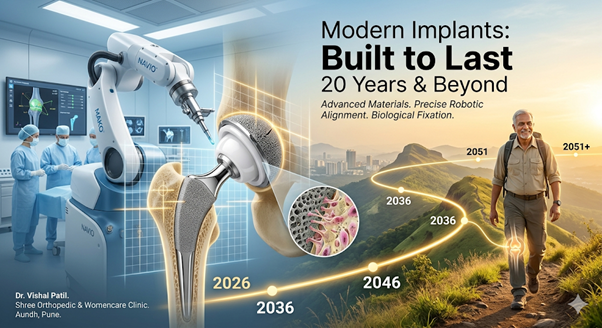
Pradeep, a 55-year-old active trekker from Pune, is standing atop a hill in the Sahyadris, breathing in the crisp morning air. He moves with a fluidity that defies his age. What Pradeep rarely thinks about is the titanium and ceramic joint that was placed in his hip back in 2026. Two decades have passed, and his “artificial” joint hasn’t just survived—it has thrived.
For many patients visiting the Shree Orthopedic and Womencare Clinic in Aundh, the primary fear isn’t the surgery itself. It is the “expiry date.” Patients often ask, “Doctor, if I get this done now, will I be back on the operating table in ten years?”
In the 1990s, that was a valid concern. Today, it is a myth. Thanks to a revolution in material science (Tribology) and surgical precision, the joints we implant today are designed to last 20, 25, or even 30 years. Here is the science behind the “Longevity Factor.”
The Evolution of Materials: Science Over Friction
The secret to an implant that lasts decades lies in a field called Tribology—the study of friction, wear, and lubrication. According to research published by the National Center for Biotechnology Information (NCBI), the failure of old-generation implants was primarily due to “wear debris.” As the joint moved, microscopic plastic particles would shed, causing the body to reject the implant.
Modern orthopedics has solved this through three major breakthroughs:
Highly Cross-Linked Polyethylene (HXLPE)
The “plastic” liner used in the 90s was susceptible to wear. Modern HXLPE is treated with radiation to create stronger molecular bonds. This material has reduced wear rates by over 90%, making “plastic wear” almost a thing of the past.
Advanced Ceramics and Oxinium
For many Hip Replacement patients, we now use ceramic-on-ceramic or ceramic-on-plastic interfaces. These surfaces are incredibly smooth, meaning there is almost zero friction. This is especially critical for younger patients in Pune dealing with Avascular Necrosis (AVN), who need their implants to last through decades of active use.
Titanium and Biological Fixation
Instead of just “gluing” the bone to the metal with cement, modern implants often use porous titanium. This surface mimics the structure of real bone, encouraging your own bone to grow into the implant. This “biological lock” ensures the joint becomes a permanent part of your anatomy.
Precision: The “Alignment” Secret
Even the best material will fail if it is put in crooked. Think of it like a car tire: if the alignment is off, the tread wears out in six months. If the alignment is perfect, the tire lasts for years.
This is where technology meets the “Longevity Factor.” At our clinic, we don’t rely on the naked eye alone.
Robotic Knee Replacement Surgery: Robotic systems allow for sub-millimeter precision. By ensuring the implant is aligned perfectly with your mechanical axis, we ensure the weight is distributed evenly, preventing premature wear on one side of the joint.
Minimally Invasive Subvastus Knee Replacement Surgery: By preserving the quadriceps muscle, we ensure the joint is stable from day one. A stable joint is a long-lasting joint.
The Domino Effect: Why Longevity Matters for Young Pune
We are seeing a trend where younger professionals—some in their 30s and 40s—require intervention due to Fractures / Trauma / Accident or lifestyle-driven joint decay. For these patients, the “20-year-plus” factor is non-negotiable.
If an implant fails prematurely, it requires a Revision Hip Replacement or a Revision Knee Replacement. While these procedures are highly successful in the hands of an expert Ortho surgeon, our primary goal is to “get it right the first time” so a revision is never needed.
Beyond the Metal: The Human Element
Longevity isn’t just about what happens in the theater. It’s about how you treat the joint afterward.
As a Best Joint Replacement Surgeon in Pune, I emphasize that the “Longevity Factor” is a partnership. While the titanium is strong, the muscles surrounding it must be stronger. This is why Post-Op Physical Therapy is the most critical phase of your journey.
In the weeks following a Total Hip Replacement Surgery, we work on strengthening the glutes and core. For knee patients, we focus on quad stability. If you aren’t yet at the stage of surgery, General Physical Therapy can often delay the need for an implant by years by improving your joint’s natural lubrication and support.
Reclaiming a Lifetime of Movement
The “Sci-Fi” future where joints are permanent is already here. Whether you are recovering from a Ratator cuff tear via Shoulder Arthroscopy or seeking a solution for a Recurrant shoulder dislocation, modern medicine is focused on one thing: Permanence.
You shouldn’t have to live your life in 10-year increments. With modern robotic precision and space-age materials, your new joint is built to be a lifelong companion, not a temporary fix.
Consult the Best Orthopedic Doctor In Aundh Today
If you are ready to invest in a lifetime of mobility, visit us at the Shree Orthopedic and Womencare Clinic. We specialize in advanced joint reconstruction designed to keep you moving well into the future.
📍 Address: Dr Vishal Patil, Shop No 205 second floor, Gaikwad Villa, Seasons Rd, opposite Punjab National Bank, Sahil Park, Sanewadi, Aundh, Pune, Maharashtra 411067. 📞 Phone: +91 94054 31728 🌐 Website: drvishalpatil.in