The “Sci-Fi” Future: How Miniaturized Robots are Making Spine Surgery Safer for Seniors – By Dr. Vishal Patil Best Orthopedic Surgeon in Aundh & Pune
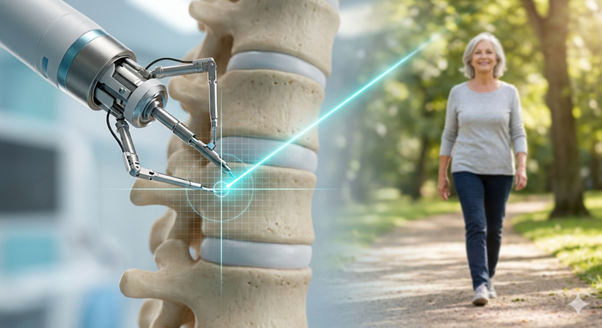
Imagine a machine no larger than a soda can, possessing the steady hand of a master surgeon and the precision of a laser-guided missile.
For 72-year-old Mrs. Deshpande, a resident of Aundh, the idea of spine surgery was more terrifying than the chronic, debilitating back pain she had endured for a decade. Like many seniors in Pune, she had heard the “old” stories: long recovery times, high risks of infection, and the haunting fear of “never walking the same again.” In her mind, spine surgery was a massive, invasive ordeal that her body simply couldn’t handle.
However, the “Sci-Fi” future has arrived in Pune. Today, Mrs. Deshpande’s story has a different ending. Instead of a large, traumatic incision, a miniaturized robotic assistant helped her surgeon place spinal supports with sub-millimeter accuracy. Within days, she was back to her morning walks at Chittaranjan Vatika.
This isn’t just technology; it is a revolution in safety, specifically designed for our aging population.
The Reality of Aging and the Spine
As we age, our bones naturally lose density, and our spinal structures undergo wear and tear. Conditions like spinal stenosis or herniated disks become common. For seniors, traditional “open” surgery carries significant risks:
- Greater blood loss due to larger incisions.
- Extended recovery times that lead to muscle weakening.
- Higher risk of nerve irritation when working in tight, sensitive spaces.
This is where the “miniaturized” robotic revolution changes the game.
Science Over Fiction: How it Works
Recent clinical research, such as the studies highlighted by the National Center for Biotechnology Information (NCBI), confirms that robotic-assisted spine surgery significantly reduces human error.
Think of the robot as a sophisticated GPS for the human body. Before the surgery even begins, we create a high-definition 3D map of the patient’s spine. The surgeon then uses a miniaturized robotic arm to guide instruments with a level of steadiness that no human hand—no matter how experienced—can match.
The robot doesn’t “do” the surgery; it acts as a high-precision guide. This is particularly crucial for Ortho specialists when dealing with fragile senior bones where there is zero room for error.
Why Miniaturization is the “Secret Sauce” for Seniors
In the past, robotic systems were bulky and occupied half the operating room. Modern miniaturized systems are sleek and often mounted directly onto the patient’s bone frame. This provides:
- Unmatched Precision in “Soft” Bone
Seniors often suffer from osteoporosis or low bone density. Placing screws or supports in this environment requires extreme care. Robotic systems ensure that every placement is optimized for the strongest part of the bone, reducing the risk of the hardware loosening later.
- Smaller Incisions, Faster Healing
Because the robot is so precise, surgeons can work through tiny “keyhole” incisions. For a senior, a small incision means less trauma to the muscles and a much lower risk of post-operative infection. This is the same philosophy we use in Minimally Invasive Subvastus Knee Replacement Surgery, where avoiding muscle damage is the key to getting patients back on their feet.
- Reduced Radiation Exposure
Traditional surgery often requires multiple X-rays during the procedure to check placement. Robotic systems use pre-operative mapping, which significantly reduces the amount of radiation exposure for both the patient and the surgical team.
The Domino Effect: From Spine to Joint Health
The spine is the foundation of the body. When a senior’s spine is misaligned due to pain, they often change the way they walk to compensate. This “limp” or “hunch” places uneven pressure on the hips and knees.
At our clinic in Aundh, we often see that untreated spinal issues eventually lead to a need for Total Hip Replacement Surgery or a Robotic Knee Replacement Surgery. The body is an interconnected chain; if the spine is healthy, the joints are protected.
In cases where years of misalignment have already damaged the lower joints, we may need to explore Hip Replacement or, if the damage is severe, a Revision Knee Replacement. The goal of robotic spine surgery is to stop this “joint decay” before it starts.
Life After Surgery: The Recovery Roadmap
For a senior, the surgery is only half the battle. The real victory happens in the weeks following the procedure. Because robotic surgery is less invasive, patients can begin Post-Op Physical Therapy almost immediately.
Unlike the old days of being bedridden for weeks, modern spine patients are often encouraged to walk within 24 hours. This early mobility prevents blood clots and keeps the muscles from “forgetting” how to move. For those not requiring surgery, we often recommend General Physical Therapy to strengthen the core and support the spine naturally.
Precision Across All Joints
The precision we use in the spine is the same standard we apply to every part of the body. Whether we are treating a Ratator cuff tear or a Recurrant shoulder dislocation via Shoulder Arthroscopy, the goal is always the same: Maximum result, minimum trauma.
For our seniors dealing with complex issues like Avascular Necrosis (AVN) or recovering from Fractures / Trauma / Accident, these technological advancements aren’t just “cool gadgets”—they are lifelines to independence.
Is it Time to Reclaim Your Mobility?
Age should never be a barrier to a pain-free life. If you have been told you are “too old” for spine surgery, it may be time for a second opinion based on modern robotic standards.
The “Sci-Fi” future of miniaturized robots is no longer a dream—it is a daily reality at the Shree Orthopedic and Womencare Clinic. We are here to ensure that your golden years are spent moving, exploring, and enjoying everything Pune has to offer.
Consult Dr. Vishal Patil Today
Best Joint Replacement & Robotic Surgeon in Pune
📍 Address: DR PATIL’s Shree Orthopedic and Womencare Clinic, Shop No 205, Second Floor, Gaikwad Villa, Seasons Rd, Aundh, Pune 411067.
📞 Book an Appointment: +91 94054 31728
🌐 Website: drvishalpatil.in